
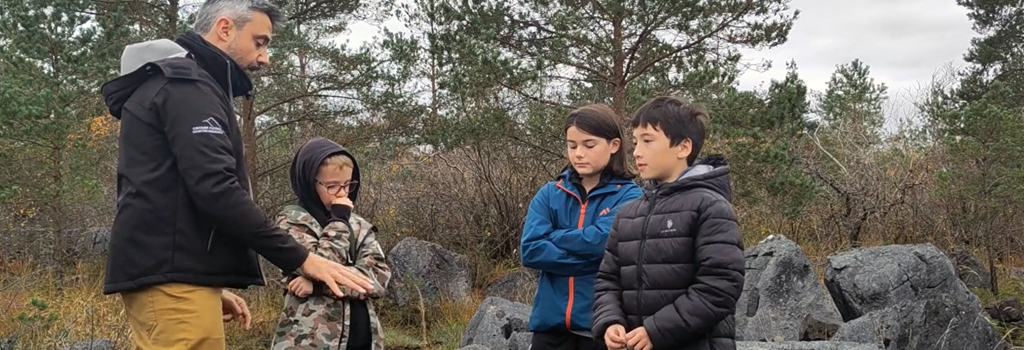
Example of an explorative conversation at a geosite
It is not easy to lead explorative conversations, and it takes practice knowing when to ask questions, when to provide information and when to allow the children time and room to wonder and explore. The most important thing is to engage the children in the exploration and keep them interested. In this example conversation you will see both more and less successful attempts at stimulating explorative conversation. Of course, when you have a whole class of students, the groups will have to discuss and explore on their own, without a teacher leading them, which would require a set of questions and tasks prepared in advance. Read more about how to organise student-led explorative group conversations.
In this example conversation, Geologist Benjamin Thébaudeau (Ben) and three young boys, (Ulysse, Chris and Tommy, all age 10) are out exploring a limestone pavement area in the village of Clonbur in the west of Ireland, on the shores of Lough Mask. The area is one of the Joyce Country and Western Lakes Geopark main geosite as it showcases a boulder field left behind by the last Ice Age and a number of epikarst features on the surface of the limestone bedrock. Some of these features, appearing as holes of various shapes and sizes, have only been recorded in this locality. The site is isolated by the surrounding woods and the lake shore, and it allows the introduction of the concept of habitats and human interaction with the landscape.
Clip 1 – Introduction to the site
As they approach the site, Ben’s first move is to ask the boys what they think about the place. As you watch the clip, consider:
- Why does he ask this question?
- What kind of answer does he get from the boys?
- What do you think would have happened if Ben instead of inviting the boys to speculate, would have started telling them facts about the place?
Ben gets both evaluative responses – what is nice and not nice – but also the boys offer escriptions, partly using scientific language (perfect circles). They also fantasise about a “big creature with round feet who stomped all over”.
This part of the conversation could have ended there, but Ben instead asks another of the boys (Chris) to contribute.
Chris expresses wonder about how this place came to be like this – this tunes his interest into finding out more.
Clip 2 – Exploring the landscape
In the next clip, Ben asks the boys to describe the phenomenon they are studying:
- What effect does the question have on the engagement and thought process, do you think?
- What kind of answers does he get?
The boys describe the site, and we see that the boys offer different kinds of theories about how the holes may have formed. Notice how Ben uses wait time and revoicing, helping the boys put words to their thoughts, and including everyone in the conversation. But their imagination does not reach a reasonable explanation, they don’t know enough to really imagine how the place might have formed. However, the interest may have reached a level where they are ready to receive information and process it.
Clip 3 – Let’s be scientists
Ben is now providing some information, but also still trying to get the boys to think what may have formed the rocks. The boys’ suggestions are not really getting them anywhere, so Ben is starting to steer the boys and select the more reasonable answers with them. Two minutes into the film, Ben summarizes what they have suggested so far, using the talk move revoicing. What do you think about the effect of Ben’s efforts to engage the children in this clip?
The talk move Ben tries to use does not really get the intended result. However, in the final part of the clip, Ben uses a reference that the boys know, and he tries to connect geological knowledge to something from «their own world», as he draws attention to the characteristics of a sandstone in a language they can understand, and you can tell that the boys’ engagement rise when that happens.
Clip 4 – Imparting knowledge
They discuss to establish some knowledge about limescale. It has to do with liquid, and it can appear at home, where you might get some acid to get rid of it. 30 seconds in, it is clear that previous knowledge has been activated, and there is no more to be imagined or remembered. Ben then fills in with information. Watch the video and try to think of what else you could have done to help the boys explore.
Did you notice how Ben provided information but also invited the boys to fill in with information that they might know?
Clip 5 – Experimenting with acid
Ben now introduces a new concept and a test to explore the nature of the rocks; Discovering the difference between limestone and sandstone by using citric acid. Notice what happens at 1:07
At 1:07 The students start talking to each other for the first time – the rest of the conversation is more of a ping-pong between the teacher and one of the students, which is very common in classroom discussions. Research shows that students generally value input from their peers more than from their teachers, and it is a goal in dialogic education to have the children discuss more amongst themselves. Here we have only a brief example of this, but try to think about how you can facilitate student discussions without the support of the teacher.